'65 Allen Organ - Design
How It All Works
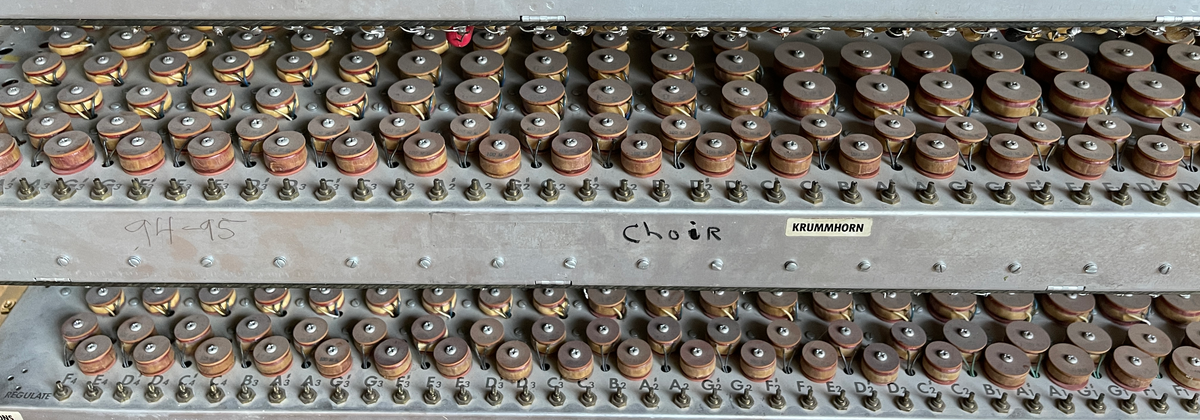
In my last post I introduced the 1965 Allen sitting in my workshop. This time, let's look inside and see how it makes its sound.
In an era of digital instruments, where sound is stored in a memory chip or SSD and sampled from real instruments, an analog organ is a different animal. Its sound is generated live inside the instrument, by circuits engineered to produce each tone.
For the purposes of these organs, an oscillator is the circuit used to create the pitch. They are little circuits that create an audio tone at a specific frequency and volume, usually a sine wave which is a very pure tone. Additional tone circuits after the oscillator will change the sine wave into something closer to the desired sound.
Manufacturers tackled this in a number of ways. Some used a batch of 13 master oscillators, each tuned to a specific note and running all the time. Divider circuits bring each note to the right octave, and filtering across the whole range of notes shapes the sound. This approach does a lot with a little, usually at the expense of tonal quality.
Other makers gave every note its own oscillator. Allen, Saville, and AOB, among others, took this route. Each tone family has as many oscillators as there are notes in its range, and the filtering that shapes the tone is done note by note or across small groups of notes.
In my organ, each tone family has its own oscillator and tone filter for every note. That gives accurate tone, since every note is custom-configured to sound right, and a broad ensemble sound, since every note is its own pitch. One C may be slightly out of tune with the next C, and so on. That tiny imperfection is what makes a big organ sound full and alive, the way a choir sounds richer than a single voice. On a divider design, all of the octaves for a note are locked to the master oscillator.
This is the more expensive approach, requiring many more parts and sturdier engineering. Allen saved some cost through unification and duplexing.
A few terms will help:
- Manual: a keyboard played with the hands. On a three-manual organ like mine, they are:
- Bottom: Choir
- Middle: Great
- Top: Swell
- Division: a grouping of sounds connected to one manual, or to the pedals
- Stop: a tab or drawknob on an organ to play a specific tone from a specific division
- Unification: getting several stops from one set of pipes or oscillators
- Duplexing: borrowing pipes or oscillators between divisions
So, on my 1965 Allen, we have a total of seven tone generators, each tone family organized on a large metal tray.
Choir Cabinet
- Choir Diapason
- Choir Quintadena
- Choir Reed (Krummhorn)
Main Cabinet
- Swell/Great/Pedal Diapason
- Swell/Great/Pedal Flute
- Swell/Pedal Reed (Trumpet)
- Swell Celeste (Soft String, Loud String, Flute)
As you can see, the Choir stops are dedicated to that manual, and actually live in their own cabinet. The larger cabinet shares the tones among the remaining two manuals and the pedal, except for the Celeste which is dedicated to the Swell and is a special tone all its own.
A celeste in an organ is a second set of pipes (or oscillators) tuned slightly off from the main sound, which creates a shimmering effect. The Allen's Celeste tray offers three voices: Soft String, Loud String, and Flute. All three come from the same oscillators, with different tone circuits for each. If both strings are selected, the Loud String wins, but the Flute can sound at the same time as either one.
The Allen uses unification to reduce the number of oscillators needed for its stops. (A quick note on the numbers you'll see: the figure in feet is the pitch. 8' is normal, 4' sounds an octave higher, and 16' an octave lower.) The main cabinet has 96 Diapason oscillators, which cover everything from the lowest pedal notes up to the highest Great stop. There are so many that the top octave had to go on blank spots on the Celeste tray! The Reed tray works the same way, supplying stops from the 16' Posaune in the pedal up to the 4' Clarion in the Swell. From one pool of oscillators, many stops are created, and their pitches overlap. If I play Middle C with the 8' Trumpet on, one oscillator sounds. Turn on the 4' Clarion instead and play the C an octave lower, and it's the very same oscillator.
The tradeoff is that two stops sharing an oscillator can't use it for different notes at the same moment, so very dense music can run into limits.
Allen has one more trick. The 8' Trumpet and the 8' Oboe share an oscillator, but one is played at a lower voltage, which makes it quieter. That gives the organ two levels of sound, which is very nice, but the two stops cannot be used together. The louder one always overrides the softer one. Almost all of the 8' stops in the instrument, along with some pedal stops, have this loud/soft configuration, providing a lot of flexibility in the volume.
Now let's follow a note from the key to the speaker. In a large Allen of this vintage, the tone cabinets are where the tone generator trays live, along with the audio amplifiers, and the power supplies that actually trigger the oscillators. Starting with the keying voltage (Allen's 'Whind' system, their name for the keying supply, of which more in the future), it goes through a long cable to the console, where it connects to the keys. Pressing a key transmits the voltage back to the cabinet, where it falls on one of 73 vertical wires of a large matrix switch. Activating a stop closes an electromagnet slide in the matrix, completing the connection back to the oscillators.
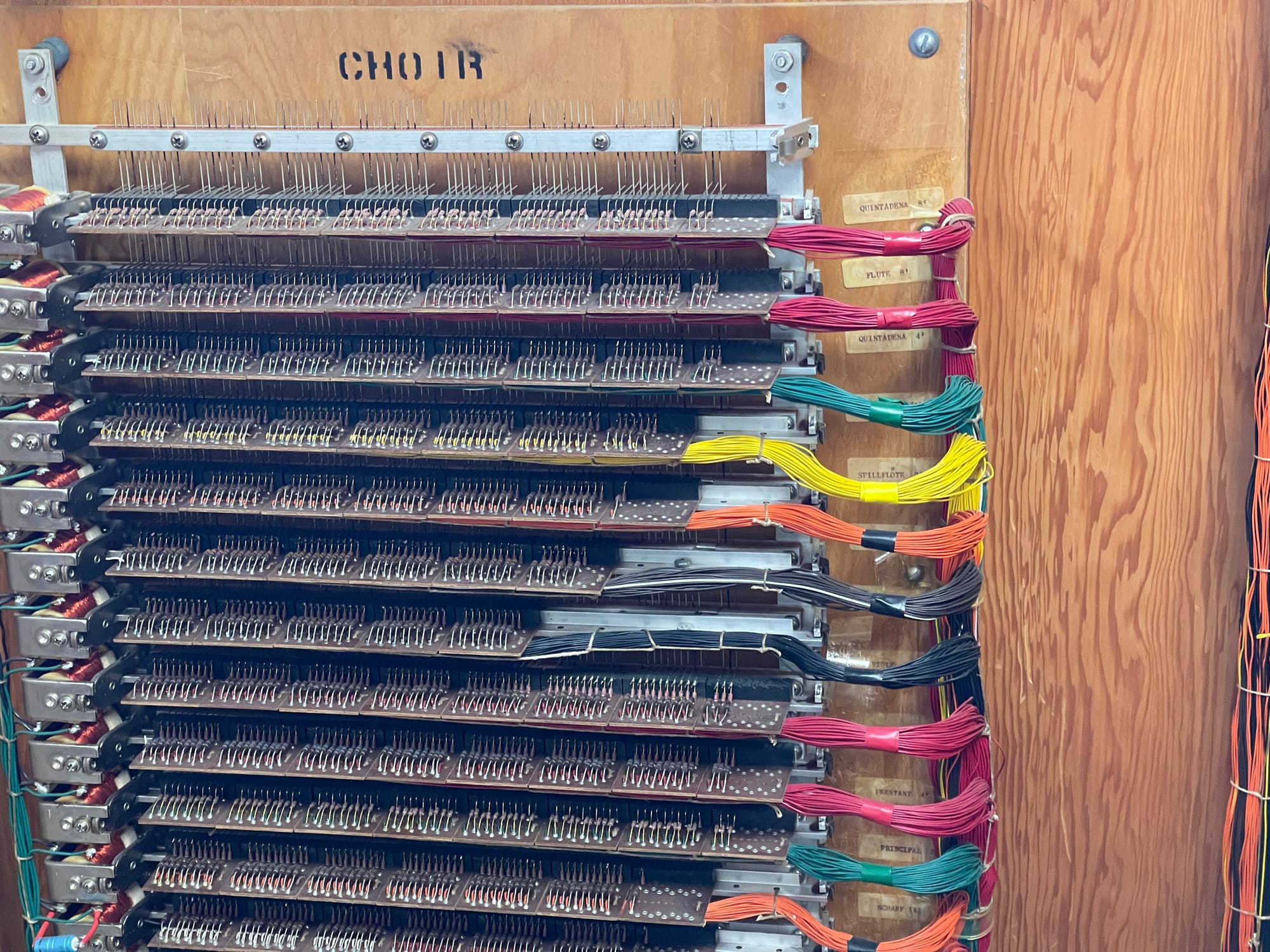
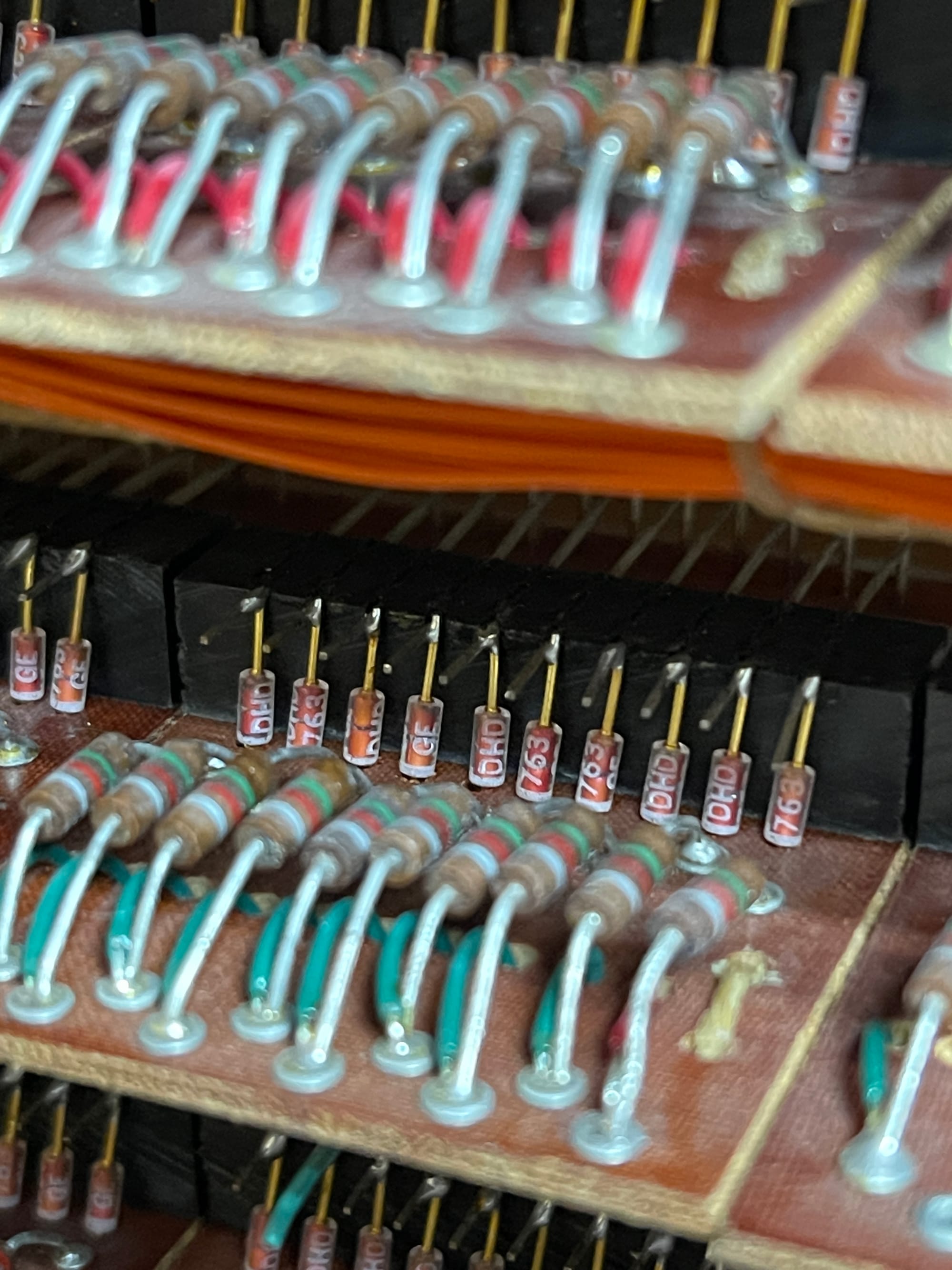
Each slide has at the very least a diode, which works like a one-way valve for electricity to prevent back-feeding between the shared oscillators, and a resistor to control the volume of the stop. Some stops activate multiple slides for the purposes of having harmonics play when a key is pressed, and harmonics are always less loud than the primary pitch.
From the matrix switch, everything goes to large junction panels in the cabinet. One side is the 'key', while the other is the 'oscillator', keeping everything organized.
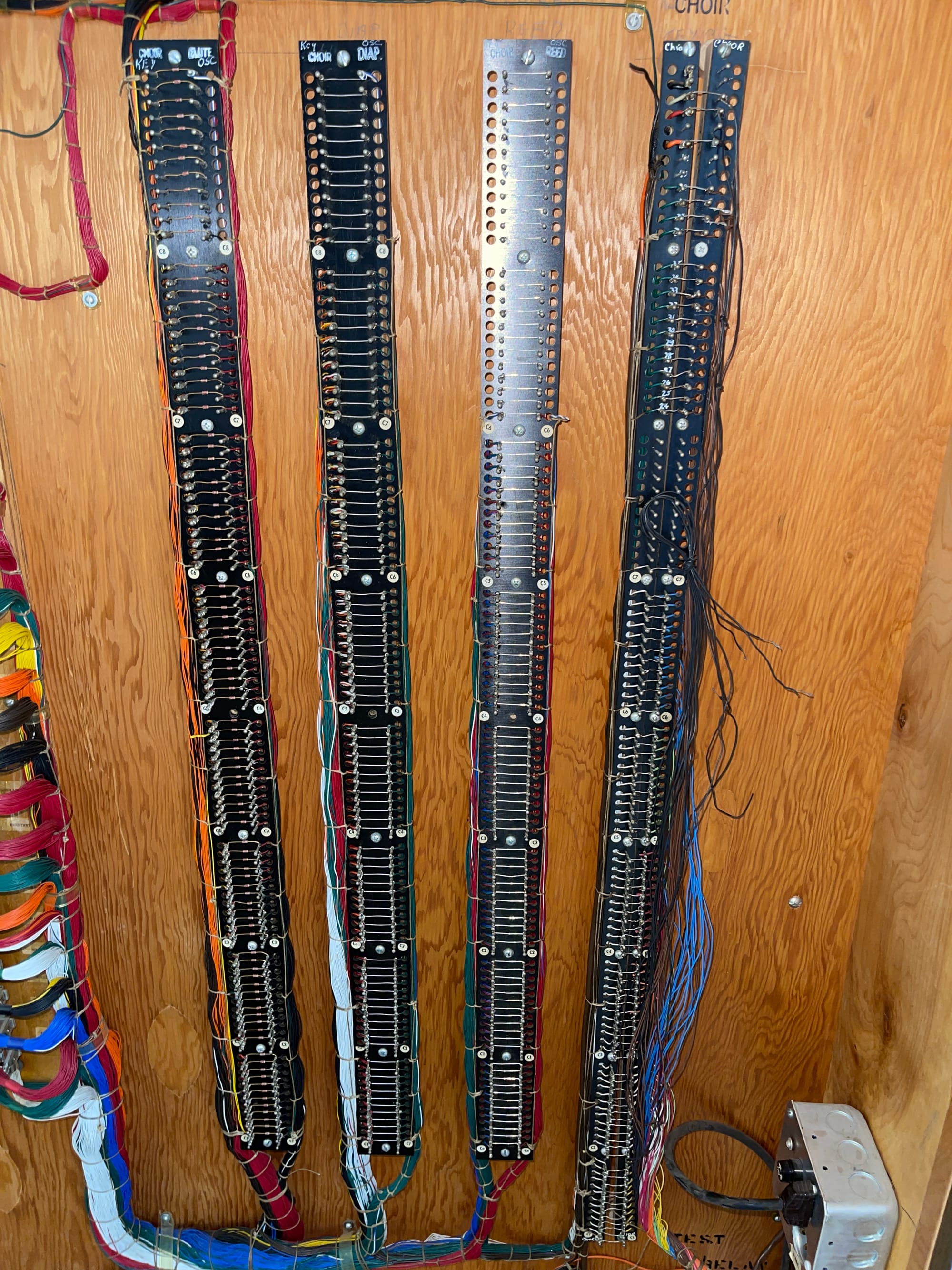
On an Allen the oscillators do nothing until a key is pressed. They are very stable oscillators, and so the proper tone begins to play immediately. The last control a player has over the sound is in the expression system.
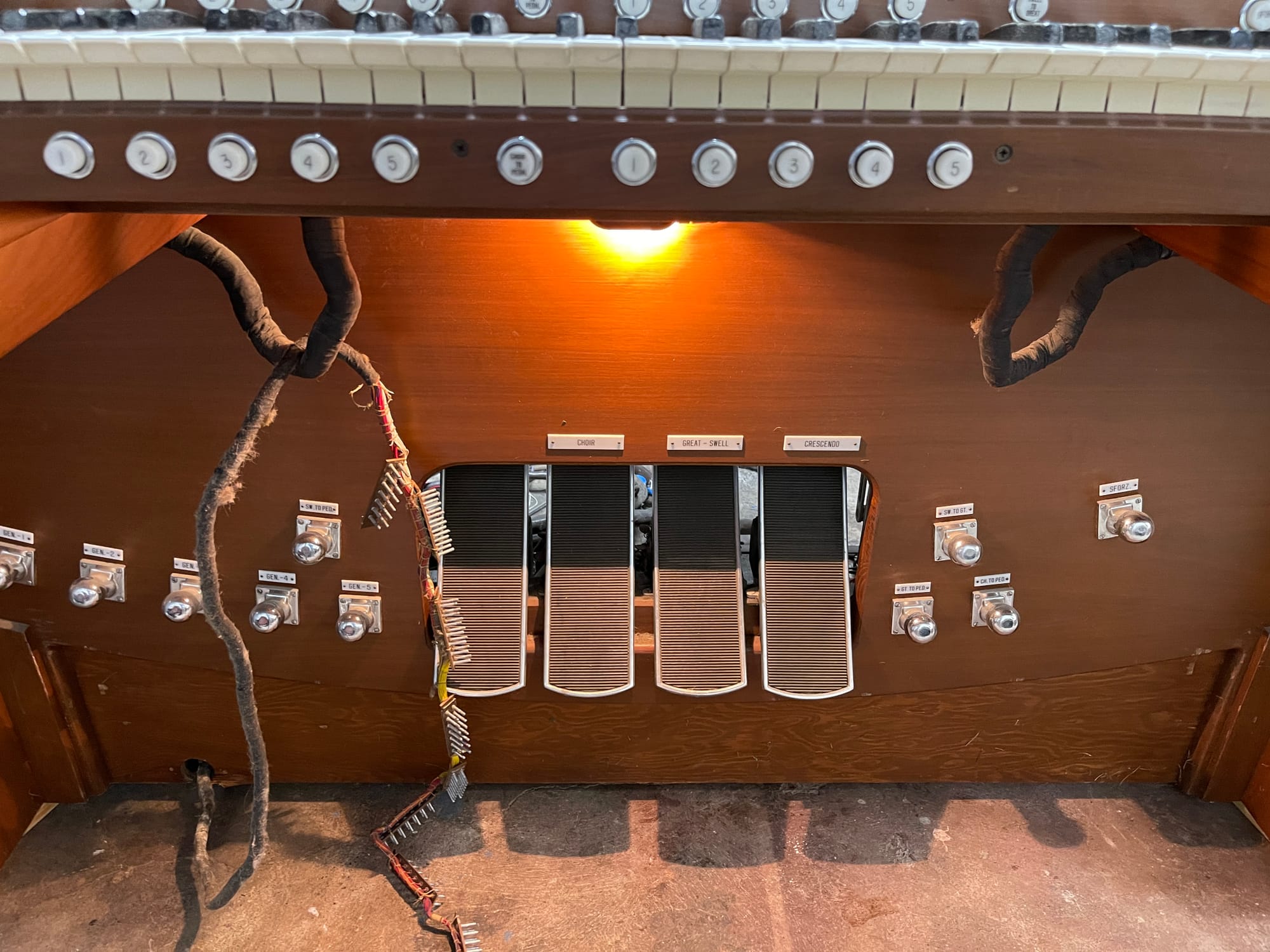
The expression pedals on a pipe organ control the volume and timbre of the sound by closing mechanical shades. On the Allen, they control the volume of the sound before it reaches the main amplifiers. Beyond just linear volume control, they do incorporate capacitors to help ensure that the lower pitches will be attenuated less than the higher pitches when expression is used. This helps retain the same effect as shutters would on a real acoustic instrument. To avoid the noise usually associated with volume controls, especially as they age, light-based shutters are used along with photo-electric resistors to make the entire expression system impervious to dirt, noise, and corrosion.
On the Allen, we can control the expression for each cabinet. An additional expression pedal on the left was installed for the Carillon system the organ was designed to integrate with, but which sadly I don't have. And the right-most pedal is the Crescendo, which activates stops increasingly loud as it's used, allowing for quick changes in the registration while playing.
I hope this gives some ideas on how the overall organ works. I hope to dive into more detail on individual systems as time goes on. For now, I leave you with this tune I recorded, which I consider one of the best pieces to date.